
Contents
Toggle📊 SEO and SEM
In the world of digital marketing, visibility on search engines plays a crucial role in business growth and online success. Every day, millions of users rely on search engines to find information, products, and services. To capture this valuable traffic, businesses use two powerful strategies: SEO and SEM. Although these terms are often mentioned together, there is a clear difference between SEO and SEM in terms of strategy, cost, execution, and long-term impact.
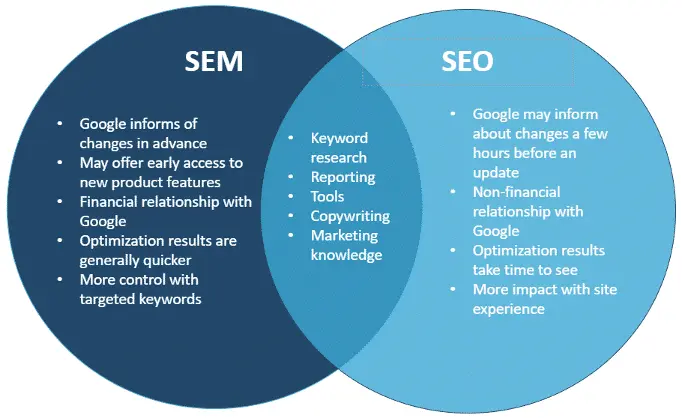
SEO focuses on improving a website’s ranking in organic (unpaid) search results through keyword research, high-quality content, technical improvements, and backlink building. In contrast, SEM is centered around paid advertising methods such as pay-per-click (PPC) campaigns that provide immediate visibility on search engine results pages (SERPs). While SEO is designed to drive organic traffic over time, SEM generates paid traffic almost instantly.
Understanding the difference between SEO and SEM is essential for businesses, marketers, and entrepreneurs who want to build an effective digital marketing strategy. The choice between organic search and paid search depends on factors such as business objectives, competition level, marketing budget, and expected timeline for results. Companies aiming for sustainable, long-term growth often prioritize SEO, whereas businesses seeking quick visibility, lead generation, or product promotion may invest more heavily in SEM.
In today’s competitive online landscape, knowing how SEO and SEM function individually — and how they can work together — can significantly improve brand visibility, website traffic, conversion rates, and overall return on investment (ROI). This article provides a detailed comparison of SEO vs SEM, highlighting their key differences, advantages, disadvantages, and strategic benefits to help you determine the best approach for your business goals.
🔎 What is SEO?
SEO (Search Engine Optimization) is the process of improving a website to rank higher in organic (unpaid) search results.
It focuses on optimizing content, website structure, and technical factors so search engines can easily understand and rank the site.
Key features of SEO:
Generates free organic traffic
Takes time to show results
Focuses on content quality and keywords
Improves website performance and user experience
Builds long-term authority and trust
Results are sustainable over time
Example:
When users search for information and click results that are not marked as ads, those are SEO results.
💰 What is SEM?
SEM (Search Engine Marketing) is a broader strategy that involves promoting websites through paid advertisements on search engines.
Most commonly, SEM refers to Pay-Per-Click (PPC) advertising, where businesses pay each time someone clicks their ad.
Key features of SEM:
Generates paid traffic
Produces immediate results
Ads appear at the top of search results
Requires a budget for bidding on keywords
Highly targeted by location, device, time, and audience
Traffic stops when the budget ends
Example:
Search results labeled “Ad” or “Sponsored” at the top are SEM ads.
⚖️ Key Differences Between SEO and SEM
| Factor | SEO | SEM |
|---|---|---|
| Meaning | Organic optimization | Paid advertising |
| Cost | No payment per click | Pay per click |
| Speed | Slow but steady | Instant results |
| Placement | Organic listings | Top sponsored results |
| Longevity | Long-term | Short-term |
| Trust level | Higher | Moderate |
| ROI timeline | Long-term return | Immediate return |
🎯 When Should You Use SEO?
SEO is best when:
You want long-term brand growth
You have time to invest
You want sustainable traffic
You aim to build authority
🚀 When Should You Use SEM?
SEM is ideal when:
You want immediate traffic
You are launching a product
You are running seasonal promotions
You operate in a highly competitive marke
In conclusion, SEO and SEM are two essential pillars of search engine marketing, each serving a distinct purpose in a digital marketing strategy. While both aim to increase website visibility and drive traffic from search engines, they differ significantly in approach, cost structure, timeline, and sustainability.
SEO is a long-term investment that focuses on building credibility, authority, and trust through organic search results. It requires patience, consistent effort, and high-quality content, but the rewards are sustainable and cost-effective over time. Once a website achieves strong rankings, it can generate continuous traffic without paying for every visitor.
On the other hand, SEM provides immediate visibility and faster results through paid advertising. It allows businesses to target specific audiences, control budgets, and measure performance accurately. SEM is particularly useful for product launches, promotions, competitive industries, or businesses that need quick conversions. However, traffic from SEM depends entirely on the advertising budget, and results stop when spending stops.
Rather than choosing one over the other, the most effective digital marketing strategies combine both SEO and SEM. SEM can generate instant traffic and valuable keyword data, while SEO builds long-term brand strength and reduces dependency on paid ads. Together, they create a balanced strategy that supports both short-term goals and long-term growth.
Ultimately, the choice between SEO and SEM depends on business objectives, budget availability, competition level, and timeline expectations. Understanding their differences allows marketers to make informed decisions and maximize return on investment in the ever-evolving digital landscape.