
Powerful On-Page SEO Optimization Techniques
On-Page SEO refers to the practice of optimizing individual web pages to improve their search engine rankings and attract relevant organic traffic. It focuses on both content and HTML source code elements that help search engines understand a page’s relevance, quality, and user value.
A well-executed on-page SEO strategy enhances visibility, improves user experience, and strengthens overall website performance.
key Elements of On - page SEO
1.KeyWord Research and Placement
Keywords are the foundation of on-page SEO. Identifying and strategically placing relevant keywords ensures alignment with user search intent.
Best Practices Include:
- Using primary keywords in the page title, headings, URL, and opening paragraph
- Incorporating secondary and long – tail keywords naturally within the content
- Avoiding keyword stuffing to maintain readability and relevance
Proper keyword usage helps search engines match content with queries.
2.High – Quality Content Optimization
Content is the most critical component of on-page SEO. Search engines prioritize pages that deliver value, clarity, and originality.
Effective content optimization involves:
- Creating informative, original, and engaging content
- Addressing user intent and search queries comprehensively
- Structuring content with clear headings and subheadings
- Regularly updating content to maintain relevance
well – optimized content improves dwell time and reduced bounce rates.
3.Title Tags Optimization
Title tags are one of the most important ranking factors and the first element users see in search results.
Optimization Guidelines:
- Keep titles between 50 – 60 characters
- Include the primary keyword near the beginning
- Make titles compelling and user – focused
Optimized title tags improve click – through rates (CTR) and visibility.
4.Meta Description Optimization
Meta descriptions provide a summary of the page content and influence user engagement.
Best Practices:
- Maintain a length of 150 -160 characters
- Include relevant keywords naturally
- Write clear , persuasive descriptions
- Although not a direct ranking factor , strong meta descriptions enhance CTR
5. URL Structure
SEO friendly URLs improve both user experience and search engine understanding.
Characteristics Of Optimized URLs:
- Short, descriptive, and readable
- Include target keywords
- Avoid unnecessary symbols or numbers
Clean URLs Increase Trust and Usability
6.Header Tags (H1 – H6)
Header tags help organize content and signal importance to search engines.
Usage Guidelines:
- Use one H1 tag per page with the primary keyword
- Use H2 – H6 tags to structure subtopics
- Maintain logical content hierarchy
- Proper header usage enhances readability and crawlability.
7. Image Optimization
Image enhance user engagement but must be optimized to avoid performance issues.
Image SEO best practices:
- Use descriptive file names
- Add keyword – relevant alt text
- Compress images to reduce load time
- Use responsive image formats
Optimized images contribute to faster page speed and accessibility.
8. Internal Linking
Internal links connect related pages within a website, improving navigation and SEO value distribution.
Benefits Include:
- Better crawlability and indexing
- Increased user engagement
- Distribution of page authority
Anchor text should be relevant and descriptive .
9. Page Speed Optimization
Page speed is a critical ranking and user experience factor.
Optimization Techniques Include :
- Minimizing CSS and JavaScript
- Leveraging browser Caching
- Optimizing images and hosting
Faster pages lead to higher engagement and lower bounce rates.
10. Mobile Optimization
With mobile – first indexing, search engines primarily evaluate the mobile version of a website.
Key Consideration:
- Responsive design
- Easy navigation on small screens
- Fast mobile load times
Mobile optimization is essential for ranking and usability.
11. User Experience (UX) Signals
Search engines assess how users interact with a page.
Important UX factors include:
- Clear layout readability
- Low bounce rate
- High dwell time
- Easy navigation
Positive user signals indicate content relevance and quality.
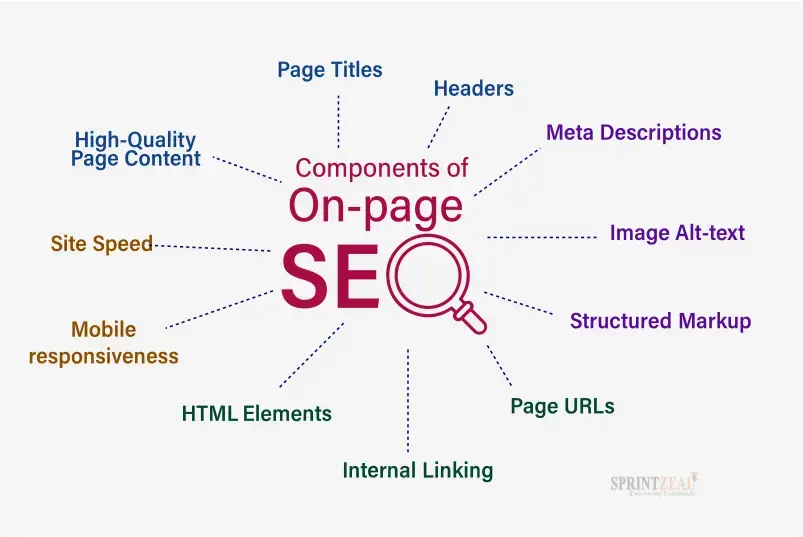
On-page SEO plays a critical role in determining how effectively a website communicates its value to both users and search engines. It involves the strategic optimization of all elements within a webpage, including high-quality and relevant content, proper keyword research and placement, optimized title tags and meta descriptions, clear heading structures, SEO-friendly URLs, internal linking, image optimization, mobile responsiveness, and fast page loading speeds. When these elements work together, they improve crawlability, indexability, and overall user experience.
Beyond rankings, strong on-page SEO helps establish topical relevance and authority by aligning content with user search intent. Well-structured and informative pages reduce bounce rates, increase dwell time, and encourage user interaction, all of which send positive signals to search engines. Additionally, on-page optimization ensures accessibility and usability across devices, making content easier to navigate and understand.
In conclusion, on-page SEO is not a one-time task but an ongoing process that requires regular updates, performance monitoring, and content improvements. When implemented consistently and strategically, it forms the foundation of a successful digital presence, supporting higher search engine rankings, sustained organic traffic growth, and improved conversions over the long term.
Pingback: Search Engine Optimization
Pingback: On-Page SEO - muhammedmishab.com