
Contents
ToggleHow Search Engine Marketing Can Skyrocket Your Website Traffic
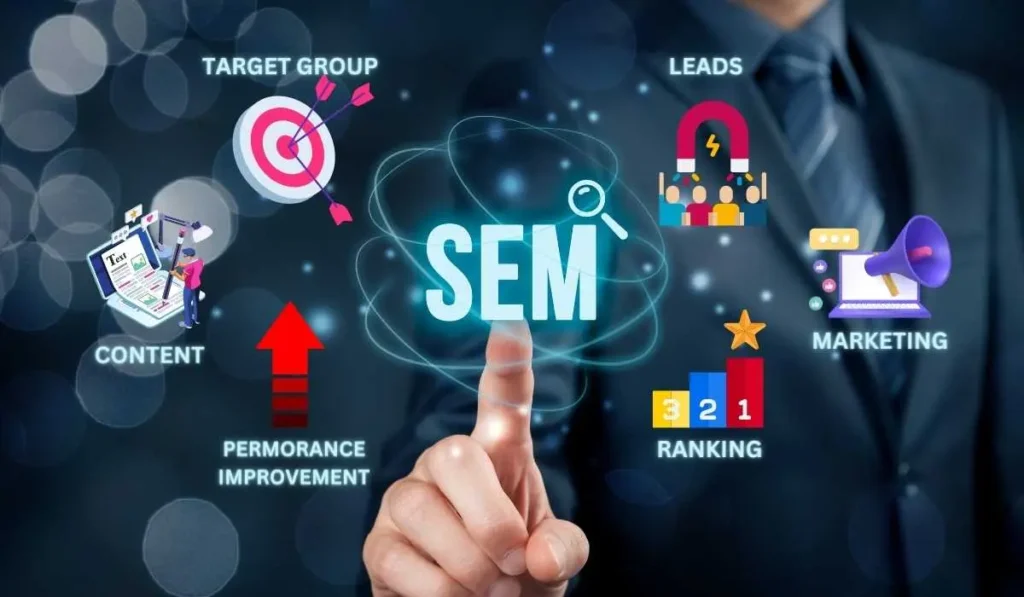
Search Engine Marketing (SEM) is a digital marketing strategy used to increase a website’s visibility on search engine results pages (SERPs) through paid advertising. Search engine marketing primarily involves Pay-Per-Click (PPC) campaigns where advertisers bid on keywords that users search for on platforms like Google, Bing, and Yahoo.
Search engine marketing helps businesses appear at the top of search results instantly, making it one of the most effective methods to generate high-intent traffic, leads, and sales.
1. How SEM Works
Search Engine Marketing operates through an auction-based system:
Advertisers select relevant keywords
They set a bid (how much they are willing to pay per click)
Create ad copies
Search engines evaluate ads based on:
Bid amount
Quality Score
Ad relevance
Landing page experience
The best-performing ads appear at the top of search results.
2. Most powerful Key Components of Search Engine Marketing
a) Keywords
Keywords are the foundation of search engine marketing. They represent what users type into search engines.
Short-tail keywords (e.g., shoes)
Long-tail keywords (e.g., best running shoes for men)
Proper keyword research ensures high relevance and better ROI.
b) Ad Copy
Ad copy is the text shown in paid search ads.
Includes:
Headline
Description
Display URL
Call-to-Action (CTA)
A compelling ad copy improves Click-Through Rate (CTR).
c) Landing Pages
Landing pages are where users land after clicking an ad.
A good landing page should:
Match the ad intent
Load fast
Be mobile-friendly
Have a clear CTA
Landing page quality directly affects Quality Score.
d) Bidding Strategy
Common bidding models:
CPC (Cost Per Click)
CPM (Cost Per Thousand Impressions)
CPA (Cost Per Acquisition)
Smart bidding helps control costs and maximize conversions.
e) Quality Score
Quality Score is a metric used by Google to measure ad quality.
It depends on:
Keyword relevance
Ad relevance
Landing page experience
Higher Quality Score = lower cost & better ad position.
1. Search Ads
Appear on SERPs
Text-based ads
High intent & high conversion rate
2. Display Ads
Visual banner ads
Shown on websites, apps, and YouTube
Used mainly for brand awareness
3. Shopping Ads
Product-based ads
Show product image, price, and brand
Ideal for e-commerce businesses
4. Video Ads
Shown on YouTube
Great for storytelling and brand engagement
5. Remarketing Ads
Target users who previously visited your website
High conversion potential
4. Advantages of Search Engine Marketing
Instant visibility on search engines
Highly targeted advertising
Measurable results
Budget control
Faster ROI compared to SEO
Works well for competitive markets
5. Challenges of Search Engine Marketing
Can be expensive in competitive industries
Requires continuous optimization
Click fraud risk
Results stop when ads stop
Needs technical expertise
6. SEM vs SEO
| Aspect | SEM | SEO |
|---|---|---|
| Cost | Paid | Organic |
| Results | Immediate | Long-term |
| Visibility | Instant | Gradual |
| Sustainability | Short-term | Long-term |
| Traffic | Paid | Free |
Best strategy: Combine SEM + SEO for maximum performance.
Google Ads
Google Keyword Planner
SEMrush
Ahrefs
Bing Ads
Google Analytics
Google Tag Manager
8. Best Practices for Effective Search Engine Marketing
Perform in-depth keyword research
Use negative keywords
Write compelling ad copies
Optimize landing pages
Track conversions
Continuously test and optimize ads
Search Engine Marketing (SEM) is a powerful digital marketing technique that helps businesses achieve immediate visibility, attract high-intent customers, and drive measurable growth. When executed strategically with proper keyword targeting, ad optimization, and performance tracking, SEM delivers fast, scalable, and profitable results. For best outcomes, SEM should be integrated with SEO and other digital marketing strategies.
In today’s highly competitive digital landscape, Search Engine Marketing (SEM) stands out as one of the fastest and most effective ways to connect with potential customers exactly when they are searching for solutions. Unlike organic strategies that take time to build momentum, SEM—especially through platforms like Google Ads—delivers immediate visibility, measurable results, and precise targeting that businesses of all sizes can leverage.
Throughout this guide, we’ve seen how SEM combines paid advertising, keyword strategy, compelling ad copy, and optimized landing pages to drive qualified traffic and conversions. From boosting brand awareness to generating high-intent leads and sales, SEM allows marketers to control budgets, track performance in real time, and continuously refine campaigns for maximum return on investment. When executed strategically, it not only increases website visits but also ensures those visits come from users most likely to take action.
However, success in SEM is not simply about running ads—it requires ongoing testing, data analysis, and adaptation to evolving search behaviors, competition, and algorithm changes. Factors such as Quality Score, bidding strategies, audience targeting, and user experience all play a crucial role in determining campaign effectiveness. Businesses that invest in learning and optimization gain a significant competitive advantage in crowded markets.
Most importantly, SEM works best as part of a holistic digital marketing strategy. When integrated with search engine optimization (SEO), content marketing, and conversion rate optimization, it creates a powerful ecosystem that captures demand, nurtures prospects, and drives sustainable growth. While SEO builds long-term authority, SEM delivers instant traction—together, they form a balanced approach to dominating search results.
In conclusion, Search Engine Marketing is not just a promotional tactic but a strategic growth engine. Whether you are a startup seeking quick visibility, a local business targeting nearby customers, or an established brand scaling revenue, SEM provides the tools to reach the right audience at the right time with the right message. By focusing on continuous improvement, data-driven decisions, and customer intent, businesses can transform SEM from a simple advertising channel into a consistent source of measurable success.
Ultimately, those who master SEM don’t just compete in search results—they lead them.
Pingback: What is Digital marketing
Pingback: Search Engine Marketing Campaigns
Pingback: Difference Between SEO and SEM