
Contents
ToggleWhat is Content Marketing
Content Marketing is a strategic marketing approach focused on creating and distributing valuable, relevant, and consistent content to attract and engage a clearly defined audience — with the ultimate goal of driving profitable customer action.
Instead of directly promoting products or services, content marketing builds trust, authority, and relationships by providing useful information.
Why is it Important
Builds Brand Awareness – Helps people discover your brand.
Generates Leads – Educates potential customers and moves them toward buying.
Improves SEO – High-quality content helps rank higher on search engines.
Builds Trust & Authority – Makes your brand an expert in your industry.
Types of Content-Marketing
1️⃣ Blog Posts
Educational articles optimized for SEO.
Example: “Top Digital Marketing Strategies for Small Businesses”
2️⃣ Social Media Content
Posts, reels, carousels, stories, and short videos on platforms like:
Facebook
Instagram
LinkedIn
YouTube
3️⃣ Video Content
Explainer videos, tutorials, product demos, webinars.
4️⃣ Email Marketing
Newsletters, promotional emails, educational sequences.
5️⃣ Infographics
Visual representation of information or statistics.
6️⃣ E-books & Guides
In-depth downloadable resources.
7️⃣ Case Studies
Real-life success stories that build credibility.
How it Process
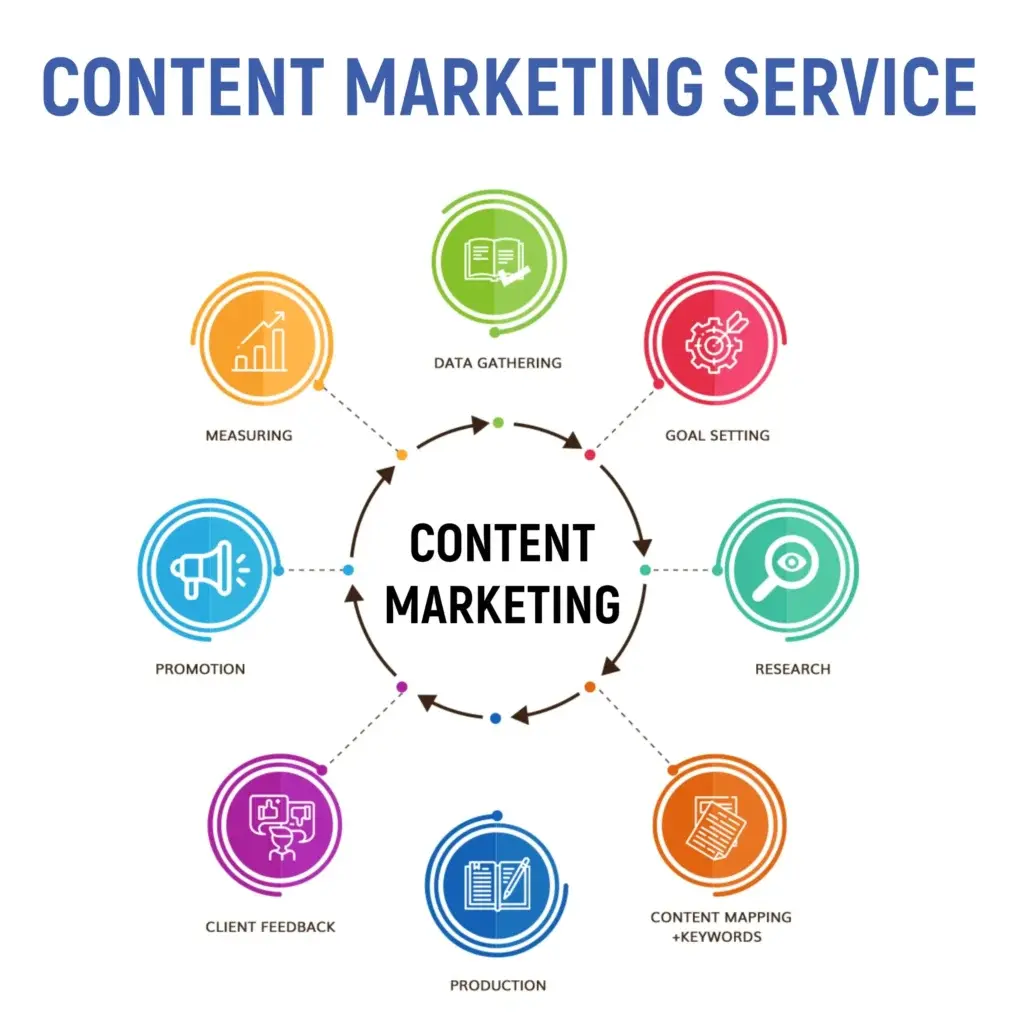
1️⃣ Audience Research
Identify target audience
Understand their pain points
Study competitors
Create buyer personas
2️⃣ Content Strategy
Define goals (traffic, leads, sales)
Keyword research
Decide content formats
Create content calendar
3️⃣ Content Creation
Write high-quality, original content
Use simple language
Add visuals
Optimize for SEO
4️⃣ Content Distribution
Publish on website/blog
Share on social media
Email subscribers
Promote using paid ads
5️⃣ Performance Measurement
Track metrics like:
Traffic
Engagement rate
Click-Through Rate (CTR)
Conversion rate
Leads generated
Tools used:
Google Analytics
Google Search Console
SEMrush
Content Marketing Funnel
🟢 Top of Funnel (TOFU) – Awareness
Blog posts, social media posts, videos
Goal: Attract new audience
🟡 Middle of Funnel (MOFU) – Consideration
Case studies, webinars, email newsletters
Goal: Educate and build trust
🔴 Bottom of Funnel (BOFU) – Decision
Product demos, testimonials, free trials
Goal: Convert into customers
Key Elements of Successful Content Marketing
Consistency
Value-driven content
SEO optimization
Clear call-to-action (CTA)
Audience-focused messaging
Storytelling
Example
Imagine you are a freelance digital marketer in Kannur.
Instead of posting:
“Hire me for digital marketing services.”
You post:
“How Small Businesses in Kannur Can Increase Sales Using Instagram”
“SEO Tips for Local Businesses in Kerala”
This attracts business owners. They trust your knowledge. Then they contact you.
👉 That is content marketing.
Benefits of Content Marketing
✔ Long-term results
✔ Cost-effective
✔ Builds brand loyalty
✔ Improves search engine ranking
✔ Generates organic leads
Difference Between Content Marketing & Traditional Marketing
| Content Marketing | Traditional Marketing |
|---|---|
| Educates audience | Direct selling |
| Long-term strategy | Short-term campaigns |
| Builds trust | Focus on promotion |
| Organic growth | Paid advertisements |
Conclusion
Content marketing is not about selling immediately.It is about educating, helping, and building relationships — so when customers are ready to buy, they choose your brand. It has become an essential pillar of modern digital marketing because it focuses on creating long-term value rather than short-term promotion. By delivering informative, engaging, and relevant content, businesses are able to connect with their audiences on a deeper level, building trust and credibility over time. Effective content- marketing supports every stage of the customer journey — from raising awareness and educating potential customers to nurturing leads and encouraging conversions. It allows brands to position themselves as industry authorities while addressing real customer needs and pain points. Moreover, when content is guided by data, optimized for search engines, and distributed through the right channels, it can generate consistent organic traffic and measurable returns. Although content marketing requires patience, creativity, and strategic planning, its long-term benefits are significant. Brands that remain consistent, audience-focused, and adaptable are more likely to achieve sustained growth, stronger customer relationships, and a competitive advantage in an increasingly digital marketplace.
Furthermore, strong content- marketing encourages customer loyalty by continuously providing value even after a purchase is made. It also creates opportunities for meaningful engagement through feedback, social sharing, and community building. Ultimately, businesses that invest in strategic content- marketing are better positioned to thrive in an ever-evolving digital world.
Pingback: What is Digital marketing